The White Edge of the Island
At the northwestern tip of Corfu, where the island narrows to a point above the village of Peroulades, the land falls away in a series of white clay cliffs that drop sixty metres into water so blue it looks doctored in photographs. This is Cape Drastis — one of the most dramatic coastal formations in the Ionian, and one of the few places in Corfu that genuinely makes people stop and stare.
From land, Cape Drastis is visible from the clifftop viewpoint above the old Peroulades path. The view is arresting: mushroom-shaped rock pillars carved by erosion, layered white and ochre sediment, and a labyrinth of sea channels running between isolated rock platforms. But the real Cape Drastis — the one that stays with you — is seen from the water.
Getting There by Private Boat
Cape Drastis sits on Corfu’s far northwest coast, roughly 35 kilometres by road from Corfu Town but accessible by boat from any departure point on the island. From Gouvia Marina or Corfu Town’s old port, the cruise northwest takes approximately sixty to seventy-five minutes.
The route follows the north coast past Kassiopi, through the narrow strait opposite Albania’s Butrint peninsula, then west along the dramatic stretch of coast that includes Sidari, the Canal d’Amour, and finally the open headland of Cape Drastis.
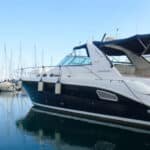
A private boat charter is the only practical way to experience Cape Drastis from sea level. No excursion boats visit the cape itself — it is too exposed and the anchorage too small for large vessels. This makes it one of the genuinely exclusive experiences available from Corfu.
The Approach from the Sea
The first sign of Cape Drastis from the water is a change in the coastline character. The green, wooded shores of northeast Corfu give way to increasingly dramatic cliff faces as you round the northern tip. Near Sidari, the sandstone forms the famous Canal d’Amour — a narrow channel between weathered rock walls that looks like a natural canal.
Then the cliffs grow taller and whiter. The mushroom rocks appear first as silhouettes, then resolve into extraordinary shapes — columns of white clay topped with tufts of vegetation, separated from the main cliff by channels barely wide enough for a boat to pass through.
What You See at Cape Drastis
The Rock Formations
The signature feature is a cluster of freestanding rock pillars — sometimes called “mushroom rocks” — carved by millennia of wave action and rain erosion. The white clay and sandstone layers create a banded appearance, with darker ochre streaks running through the pale stone. The pillars stand between five and twenty metres tall, with flat tops where scrubby plants somehow cling.
Between the pillars, narrow channels of deep blue water create natural swimming lanes. On calm days, your skipper can navigate between the formations, giving you a perspective that is impossible from shore.
The Secret Beaches
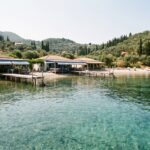
At the base of the Cape Drastis cliffs, several tiny beaches exist that are completely invisible from above and unreachable by land. These are narrow strips of white sand and pebble, backed by vertical clay walls, with water that graduates from pale green at the shore to deep blue within a few metres.
Your skipper can anchor close enough for you to swim to these beaches. Standing on one of them, with the white cliffs rising above and the Ionian stretching to the horizon, is a genuine Robinson Crusoe moment.
The Colour Palette
Cape Drastis is a photographer’s subject because of its contrasts. The white cliffs against blue sky. The turquoise shallows against dark blue depths. The green vegetation crowning the pale stone. In morning light, the cliffs glow warm. By midday, the white intensifies to near-blinding. Late afternoon brings shadow and depth to the formations.
Swimming and Snorkelling
The waters around Cape Drastis are clear and typically calm in the morning. Swimming between the rock pillars is the highlight — the channels are sheltered, the water is warm, and the sense of being inside a natural sculpture garden is unique.
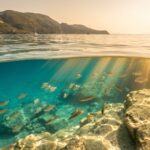
Snorkelling along the cliff base reveals a different seabed from the rest of Corfu. The white sand and clay bottom reflects light upward, illuminating everything from below. Small fish gather in the crevices of the fallen rock, and the visibility often exceeds twenty metres.
A word of caution: the cape is exposed to northwesterly winds. Afternoons can bring swell, and conditions deteriorate quickly when the wind picks up. Experienced skippers plan the Cape Drastis stop for the morning when conditions are calmest.
Combining Cape Drastis with a Northwest Corfu Tour
Cape Drastis works best as part of a full-day northwest Corfu itinerary. A typical route includes:
Canal d’Amour, Sidari
A natural sandstone channel that legend says brings eternal love to couples who swim through it. Regardless of the legend, the rock formations are genuinely impressive from the water.
Loggas Beach
Peroulades’ main beach, a narrow sand strip at the base of towering clay cliffs. Sunset here is famous, though from a boat you can appreciate it from a different angle entirely.
Porto Timoni
A twin-bay beach on the Afionas peninsula, south of Drastis. Two crescents of water — one facing north, one south — separated by a narrow isthmus. Accessible by a steep trail or, much more comfortably, by boat.
Paleokastritsa
The most famous bay complex on Corfu’s west coast, with its six coves, monastery, and sea caves. Often the final stop before heading back to the east coast. A lunch stop at one of the waterfront tavernas makes a satisfying end to the day.
This full route — east coast departure, northern passage, Cape Drastis, south along the west coast to Paleokastritsa, and back — covers the most scenic stretch of Corfu’s coastline in a single day.
Best Time to Visit
Time of Day
Morning. The light is best for photography, the winds are calmest, and you arrive before any other boats. By early afternoon, conditions can change.
Time of Year
June through September. The sea is warm enough for extended swimming, and the weather is most reliable. Cape Drastis is possible in May and October, but the northwest coast is more exposed to spring and autumn weather systems.
Photography Tips
The mushroom rocks photograph best from water level in the morning, when side-lighting emphasises the texture of the layered sediment. A wide-angle lens captures the scale of the formations. Drone photography — if you carry one and have the necessary permits — reveals the full labyrinth of channels and pillars from above.
From a boat, the best shots come as you approach the cape from the northeast, with the formations silhouetted against the western sky. Your skipper can hold position while you frame the shot.
Frequently Asked Questions
Can you visit Cape Drastis without a private boat?
You can see Cape Drastis from the clifftop viewpoint above Peroulades, which is accessible by car or foot. However, the sea-level experience — swimming between the rock formations and visiting the hidden beaches — requires a boat.
Is Cape Drastis safe for swimming?
Yes, on calm days. The waters are sheltered between the rock formations and the depth is manageable. However, the cape is exposed to northwest winds, so conditions must be assessed by an experienced skipper. SeaDreamers always monitors weather before confirming this route.
How long do you spend at Cape Drastis?
Most visitors spend 45 minutes to an hour at the cape — enough for swimming, snorkelling, and exploring the rock formations. It is typically one of several stops on a full-day northwest Corfu boat tour.
Is Cape Drastis suitable for children?
Yes, with supervision. The swimming areas between the rocks are calm and shallow enough for confident young swimmers. The boat anchors close to shore, keeping the swim distance short.
A Corfu Landmark Worth the Journey
Cape Drastis does not appear on most tourist itineraries because it is not easy to reach. That is precisely what preserves it. From a private boat, sliding between the white pillars with the morning sun overhead and the sea floor visible five metres below, you understand why the few people who visit it place it at the top of their Corfu experiences.
Contact SeaDreamers to include Cape Drastis in your private boat tour of northwest Corfu.


 English
 Ελληνικά
 Italiano
 Français
 Deutsch
 Español
 Română
 עִבְרִית