Most maps of Greece end before they get to Erikoussa, Othoni, and Mathraki. Even seasoned Corfu visitors draw a blank when you mention the Diapontia Islands — a trio of outposts scattered in the open Ionian northwest of Corfu that hold the distinction of being the westernmost inhabited territory in Greece. Out here, the water is deeper, the horizons wider, and the sense of discovery is genuine. These are not day-trip islands; these are expedition islands, and they reward the effort of reaching them.
The Diapontia group sits between 5 and 22 nautical miles off Corfu’s northwest cape. Erikoussa is the closest and most accessible, Mathraki the smallest and quietest, Othoni the largest and most remote. Together they hold a combined year-round population of roughly 500 people, most of whom earn their living from fishing and olive cultivation. Tourism exists but has not yet reshaped these islands. There are no boutique hotels, no cocktail bars, no Instagram spots marked with geotags. What you find instead is Greece at its most elemental.
Erikoussa: The Golden Beach Island
Erikoussa is the first island you reach heading northwest from Corfu, approximately 5 nautical miles from Cape Drastis. It is the most visited of the three, though “visited” is a relative term — even in August, the beaches feel private. The island’s main attraction is Porto Beach, a long crescent of fine golden sand backed by low dunes and cedar trees. The water is shallow and warm, the sand slopes gently, and the setting has an almost tropical quality.
The village of Erikoussa clusters around the small harbour on the southeast coast. A handful of tavernas line the waterfront, and Ambeloussa serves home-cooked dishes — moussaka, stuffed peppers, grilled fish caught that morning — under a vine-covered terrace. The portions are generous and the prices honest. After lunch, the walk across the island to Porto Beach takes about twenty minutes through olive groves, or your boat can reposition to anchor directly off the beach.
For snorkelling, the rocky coastline east of the harbour offers clear water and varied marine life, including octopus, grouper, and the occasional sea turtle passing through the channel.

Othoni: The Edge of Greece
Othoni is the largest and most distant of the Diapontia Islands, lying roughly 22 nautical miles northwest of Corfu. It takes its isolation seriously. The island rises steeply from the sea, with wooded hills reaching 393 metres at the summit of Mount Merovigli — the highest point of any Greek island in the Ionian. From the top, on a clear day, you can see the heel of Italy.
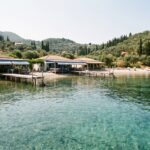
The harbour of Ammos on the south coast is where boats arrive. It is tiny — a crescent of pebble beach with a few fishing boats, a concrete quay, and three tavernas. Locanda dei Sogni, run by an Italian-Greek couple, serves the best food on the island: handmade pasta, fresh catch, and wine from the mainland. It is the kind of restaurant that should not exist in a place this remote, and yet it does, perfectly.
Othoni’s interior is wild and largely depopulated. Stone villages dot the hillside, many with only a handful of permanent residents. The church of Panagia in the village of Chorio commands views across the entire western Ionian. Walking trails connect the villages, but the island is not set up for casual hikers — paths are rough and shade is sporadic. The beaches, however, are accessible by boat: Aspri Ammos on the west side is a white-pebble cove with crystalline water, and Fyki Bay in the northwest offers dramatic cliff swimming.
Mathraki: The Quiet One
Mathraki is the smallest and least visited of the three islands, and it is precisely this quality that makes it special. With a population of fewer than 100 people, the island has one village, one harbour, one taverna, and one magnificent beach. Portello Beach runs along the western coast for over a kilometre — fine sand, shallow turquoise water, and on most days, not a soul in sight.
The island’s interior is covered in dense maquis and olive groves, with a single road connecting the harbour village to the higher ground. Taverna Christos at the harbour serves whatever was caught that day, cooked simply and served on a terrace overlooking the water. The menu does not exist in written form; Christos tells you what is available, and you nod. It is always good.
Mathraki is the island for those who have done everything else in the Ionian and want to find something untouched. It is not polished, not convenient, and not trying to be anything other than what it is: a small Greek island where the loudest sound is the wind.

The Crossing: What to Expect
Reaching the Diapontia Islands from Corfu requires a full day and a capable vessel. The crossing to Erikoussa from the northwest coast of Corfu takes approximately 30 to 45 minutes in calm conditions. Othoni adds another 45 minutes to an hour beyond Erikoussa, depending on the route. Sea conditions in the open channel can vary — the Ionian is generally calm in summer, but the fetch between Corfu and the islands can produce a moderate swell, especially in the afternoon when the thermal winds build.
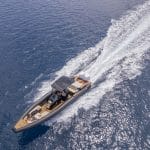
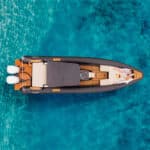
For this reason, the Diapontia Islands are best visited on days with settled weather and light winds. Your SeaDreamers captain assesses conditions before departure and plans the route accordingly. A RIB boat covers the distance fastest, but for a more comfortable crossing with amenities and shade, a larger cruiser like the Sea Ray Sundancer 370 is recommended.
Planning Your Diapontia Day
Il nostro Diapontia Islands full-day tour is structured to make the most of the crossing. A typical itinerary includes an early departure from Corfu, a morning swim and coffee stop at Erikoussa, lunch at Othoni, an afternoon swim at Mathraki or a return visit to Erikoussa’s Porto Beach, and a late-afternoon crossing back to Corfu.
Visiting all three islands in a single day is possible but ambitious. Many guests prefer to focus on two, spending longer at each. The flexibility of a private charter means the itinerary adjusts to your preferences and the conditions of the day.
Frequently Asked Questions
Can I visit all three Diapontia Islands in one day?
It is possible with an early start and a fast vessel, but spending quality time on two islands is more rewarding. Erikoussa and Othoni make the most popular combination, with Mathraki added if time and conditions allow.
Which Diapontia Island has the best beach?
Porto Beach on Erikoussa is the most conventionally beautiful — golden sand, warm shallows, dune-backed. Portello on Mathraki is wilder and more isolated. Both are exceptional and rarely crowded.
Are there restaurants on the Diapontia Islands?
Each island has at least one taverna, all serving simple, fresh, home-cooked Greek food. Locanda dei Sogni on Othoni is the standout for quality, while Taverna Christos on Mathraki offers the most authentic local experience.
What boat is best for the Diapontia Islands trip?
A larger cruiser provides the most comfortable crossing for the open-water passage. The Sea Ray 370 offers stability, shade, and onboard facilities. Your SeaDreamers captain will recommend the best vessel based on your group size and the forecast.
Where Greece Begins and the Open Sea Takes Over
The Diapontia Islands are not for everyone. They require a full day, an early start, and a willingness to trade convenience for authenticity. But for those who make the crossing, the reward is an experience of Greek island life that the rest of the Ionian has largely left behind. Empty beaches, honest food, water that makes you forget the rest of the Mediterranean exists.
Ready to reach the edge of Greece? Contact SeaDreamers to plan your Diapontia Islands expedition from Corfu.

 English
 Ελληνικά
 Italiano
 Français
 Deutsch
 Español
 Română
 עִבְרִית