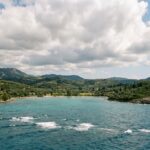
Palaiokastritsa reveals itself differently depending on how you arrive. By road, you descend through olive groves and cypress trees to a cluster of bays that seem almost too blue to be natural. By boat, the revelation is slower and more dramatic — the limestone cliffs of the northwest coast build in height and complexity until they open, suddenly, into a series of coves so sheltered and vivid they feel like rooms carved from the sea itself.
This is Corfu’s crown jewel, and from the water, it wears its crown properly. The six bays of Palaiokastritsa, the hilltop monastery, the sea caves that tunnel through the headlands — all of it was designed to be seen from the sea. Roads and car parks are an afterthought. The architecture of this coastline is nautical first.
The Six Bays of Palaiokastritsa
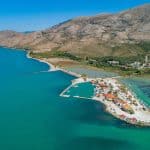
Palaiokastritsa is not a single beach but a constellation of six distinct bays, each with its own character. From the water, you can move between them in minutes, anchoring where the mood takes you.
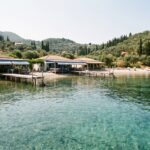
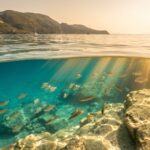
Agios Spiridon is the main bay, the one visible from the road, with sunbeds and a line of tavernas. It is the most developed and the most popular, but even here the water quality is exceptional — clear to the bottom at five metres, with small fish darting between the rocks.
Ampelaki, just south, is smaller and more sheltered. The sand is coarser, the crowds thinner, and the snorkelling along the rocky edges is excellent. Platakia und Alipa occupy the northern side of the peninsula, with Alipa functioning as a small harbour for local boats. La Grotta, arguably the most famous spot, sits beneath the cliffs south of the monastery — a rocky platform with a bar carved into the rock face, steps leading down to impossibly clear water, and a diving platform that drops you into the deep blue.
The sixth bay, Liapades, lies further south and is less visited by boat tours despite offering some of the most dramatic cliff scenery in the area. The water here transitions from emerald near the shore to deep cobalt where the seabed drops away.

The Monastery from the Sea
The Monastery of Theotokos sits atop the headland that separates the main bays, and from the water its position is commanding. The white walls and terracotta roof emerge from the green hillside like a beacon, framed by cypress trees and backed by the blue sky. It has occupied this spot since the thirteenth century, though the current buildings date from the eighteenth.
From a boat, the monastery view is unobstructed — no car parks, no souvenir stalls, just the building in its landscape as it was meant to be seen. Many of our guests request a slow pass beneath the monastery cliffs, engines at idle, while the scale of the setting sinks in. It is one of those moments where the camera cannot do justice to the reality, but you take the photograph anyway.
The Sea Caves of Palaiokastritsa
The limestone headlands around Palaiokastritsa are riddled with caves, and exploring them by boat is one of the great experiences of a Corfu cruise. The caves range from wide, shallow openings where the sunlight penetrates and turns the water electric blue, to narrow tunnels that require careful navigation and reward the curious with hidden chambers where the only sound is the echo of water on rock.
The most visited is the Blue Eye Cave, where an underwater opening allows sunlight to filter up from below, creating a luminous blue glow on the cave walls and the surface of the water. Your captain can position the boat at the entrance while you swim inside — the temperature drops, the light changes, and the effect is genuinely otherworldly.
Further along the coast toward Liapades, the Paradise Cave und Cathedral Cave are larger, with vaulted ceilings and sandy floors visible through the clear water. Smaller vessels like our Viper Grigoris can enter these caves directly, giving passengers an up-close experience of geology that took millennia to shape.

La Grotta: The Cliff Bar Worth Swimming To
La Grotta is a Corfu institution. Perched on the rocks below the monastery, accessible by a set of steep concrete steps from the road or — more dramatically — by swimming from a boat anchored in the bay, it is part bar, part natural swimming pool, part amphitheatre of rock. The diving platform juts out over deep water, and watching swimmers leap from it while you nurse a cold Aperol Spritz is one of the defining experiences of a Palaiokastritsa day.
Arriving by boat gives you the best of both worlds. You can swim in from the anchorage, climb up to the bar for a drink, and swim back to the boat when you are ready — skipping the steep walk and the road traffic entirely. It is the most elegant way to visit La Grotta, and it is how the regulars do it.
Anchoring and Practical Information
Palaiokastritsa offers several anchoring options. The main bay of Agios Spiridon has sandy bottom with moderate holding at four to seven metres depth. Ampelaki is more protected from the prevailing northwest wind and is preferred on breezy days. For a quieter experience, the bays south of La Grotta offer good anchorage away from the main traffic.
Swimming conditions are generally excellent from May through October. Water temperatures reach 26-27 degrees Celsius in August. The sea caves are best visited in the morning when the sun angles into the openings, creating the most vivid colour effects.
Combining Palaiokastritsa with a Northwest Tour
A visit to Palaiokastritsa by boat pairs naturally with a broader exploration of Corfu’s northwest coast. Heading north from Palaiokastritsa, the coastline becomes wilder and less developed. The cliffs of Angelokastro — a ruined Byzantine fortress perched on a dramatic promontory — are visible from the water and make for an impressive sailing backdrop.
Unser Northwest Corfu full-day tour includes Palaiokastritsa as a central stop, combining it with swimming at remote beaches, cliff-side exploration, and lunch at a coastal taverna. For those with a full day, extending the route north to Cape Drastis adds the famous white clay formations and some of the most photographed scenery in the Ionian.
Frequently Asked Questions
Can you enter the sea caves at Palaiokastritsa by boat?
Yes. Smaller vessels can enter the larger caves directly. For narrower caves, passengers swim in from the anchored boat. Your captain assesses conditions and accessibility on the day — calm seas allow access to more caves.
How long should I spend at Palaiokastritsa on a boat tour?
A minimum of two to three hours allows time to explore the main bays, visit the caves, and swim. A half-day or full-day charter gives you the freedom to linger, visit La Grotta, and combine with other northwest coast stops.
Is Palaiokastritsa suitable for children?
The sheltered bays with sandy shallows are ideal for families. The caves fascinate children of all ages, and the snorkelling in the rocky areas around the headlands is rich with marine life. Life jackets and floats are provided on board.
What is the best boat for visiting Palaiokastritsa?
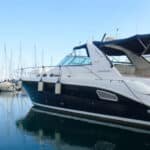
For cave exploration, a smaller RIB like the Viper Grigoris offers the best access. For a more comfortable day with multiple stops, the Marex 310C Sonnenkreuzer balances space and manoeuvrability. Your SeaDreamers advisor can recommend the ideal vessel for your group.
See the Crown Jewel from Its Best Angle
Palaiokastritsa is beautiful from the road. It is spectacular from the monastery terrace. But from the water — where the cliffs rise uninterrupted, the caves glow blue in the morning light, and the six bays reveal themselves one by one as you cruise the shoreline — it is transcendent. This is the Corfu that postcards try to capture and always fall short.
Experience Palaiokastritsa the way it was meant to be seen. Contact SeaDreamers to book your private boat tour to Corfu’s most celebrated coastline.
 English
 Ελληνικά
 Italiano
 Français
 Deutsch
 Español
 Română
 עִבְרִית