A Harbour Built for Arriving by Sea
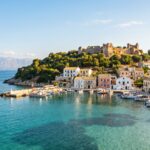
Gaios reveals itself slowly from the water. The entrance to its harbour is disguised — a narrow channel between the main island of Paxos and the tiny fortified islet of Agios Nikolaos, barely wide enough for two boats to pass. You slip through the gap, the cliffs close in on both sides, and then the channel opens into a long, protected harbour lined with pastel-coloured houses, cypress trees, and fishing boats rocking gently at their moorings.
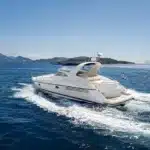
This is the kind of arrival that justifies coming by boat rather than ferry. The ferry docks at the outer quay and deposits passengers into a parking area. A private boat glides into the inner harbour and ties up beneath the plane trees, steps from the village square, with the day’s schedule entirely in your hands.
Gaios is the capital of Paxos — a title that sounds grander than the village it describes. The population is around five hundred. There is no traffic light, no high-rise, no chain restaurant. What there is: one of the most naturally beautiful small harbours in the Mediterranean, excellent food, a compelling history, and enough character to fill an afternoon without a single forced attraction.
The Village Itself
The Plateia
The village square — the plateia — sits at the head of the harbour, shaded by enormous plane trees and surrounded by kafeneia and tavernas. This is where Paxos’s social life happens: morning coffee, afternoon ouzo, evening promenades. The stone paving, the wrought-iron balconies above, and the fishing boats reflected in the water below create a scene that has barely changed in decades.
The Back Streets
Behind the waterfront, Gaios contracts into a web of narrow streets and covered passages. The architecture is Venetian — stone-built, two and three storeys, with wooden shutters in faded green and blue. Ground-floor spaces house small shops selling olive oil, local honey, handmade soap, and the kind of souvenirs that actually have taste.
A walk of ten minutes covers the entire village, but a slow exploration takes much longer. Every corner reveals a detail: a carved door lintel, a cat asleep on a stone windowsill, a vine-covered courtyard visible through an open gate.
The Olive Oil
Paxos is famous for its olive oil, and Gaios is where you find it. The island has an estimated 300,000 olive trees for a population of 2,500 — roughly 120 trees per person. The oil is prized across Greece for its low acidity and distinct flavour, a product of the ancient varietals and the Ionian climate.
Several shops in Gaios sell oil direct from local presses. Tasting is encouraged. The best oils have a peppery finish and a green, almost grassy aroma that distinguishes them from mainland Greek oil.
Where to Eat
Gaios punches above its weight for food. The competition between a dozen tavernas for a village of five hundred residents keeps standards high and prices fair.
Taka Taka
On the main waterfront, Taka Taka has been serving simple grilled food for decades. The octopus, hung to dry on the line outside, is tender and smoky. The portion of grilled sardines with lemon and oregano is generous. Tables sit directly on the quay, with the harbour boats as your view.
Carnayo
Set slightly back from the main square, Carnayo offers a more refined take on Greek cuisine. The seafood risotto and the slow-cooked lamb are highlights. The wine list favours Greek bottles with a nod to Paxos’s own production.
Rex
At the southern end of the harbour, Rex combines harbour views with a menu that balances traditional and contemporary. Their fresh fish, priced by the kilo, is reliably excellent. The baked feta with honey and sesame makes a good starter.
The Bakery
Near the square, a small bakery produces spanakopita, tiropita, and galaktoboureko that locals queue for in the morning. Grab something for the boat.
Agios Nikolaos: The Fortress Island
The tiny islet guarding the harbour entrance — Agios Nikolaos — carries a Venetian fortress built in 1423. The fortification was expanded over the centuries and served as a defence against Ottoman raids that periodically swept through the Ionian.
Today the fortress is partially ruined but accessible by a short boat ride or, at low water, a swim from the harbour wall. The walls still stand, and the views from the ramparts back toward Gaios and across to the Paxos coastline give a sense of why this location was chosen for defence.
The islet also holds a small church — the namesake Agios Nikolaos — that hosts a festival in early December.
Panagia Island
South of Agios Nikolaos, a second islet — Panagia — holds another church surrounded by cypress trees. Together, the two islets form a natural breakwater that makes Gaios harbour one of the most sheltered anchorages in the Ionian. Even in strong weather, the inner harbour stays calm.
A Short History
Paxos has been inhabited since antiquity. Greek mythology credits Poseidon with creating the island by striking the southern tip of Corfu with his trident, splitting off a piece for himself and Amphitrite to enjoy in privacy. The archaeological record is less dramatic but equally interesting: Roman ruins, early Christian churches, and Venetian fortifications layer the island’s story.
The Venetians held Paxos from 1386 to 1797 — over four centuries that shaped the architecture, the olive cultivation, and the culture. The British followed from 1814 to 1864, building roads and water cisterns that remain in use. Greek independence in 1864 returned Paxos to the nation, and it has since existed in a comfortable quiet that tourism has enhanced rather than destroyed.
Mooring in Gaios
For those arriving by private boat from a Corfu charter, Gaios offers several mooring options:
The Town Quay
Mediterranean-style stern-to mooring on the main quay, directly in front of the tavernas. Space is available on a first-come basis. The harbour master collects a modest fee.
Anchor in the Channel
For larger vessels or when the quay is full, anchoring in the channel between Gaios and Agios Nikolaos island provides a peaceful alternative. The holding is good on mud and weed. You reach shore by tender or by swimming.
How Long to Spend
Most Paxos day-trip itineraries allocate two to three hours in Gaios — enough for a meal, a village walk, and a browse through the shops. If you are spending the night on Paxos, Gaios expands into a full evening of waterfront dining, an after-dinner walk, and the particular pleasure of watching a small harbour settle into darkness.
Beyond Gaios: What Else to See on Paxos
If your day allows, Paxos’s other two villages are worth visiting:
Lakka
The northern harbour, smaller and quieter than Gaios, with a horseshoe bay, good swimming, and two excellent tavernas. Lakka is where many Corfiots keep their weekend boats.
Loggos
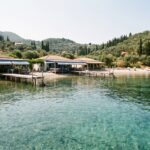
The smallest of the three, Loggos sits on the east coast between Gaios and Lakka. A tiny harbour, a stone quay, three tavernas, and a swimming platform make it a charming mid-afternoon stop.
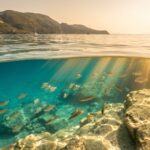
Both are accessible by boat along the sheltered east coast — a scenic cruise through water that shifts between jade and cobalt depending on the depth.
שאלות נפוצות
How long does it take to reach Gaios from Corfu by private boat?
Approximately seventy-five to ninety minutes from Gouvia Marina or Corfu Town. Faster vessels can reduce this to sixty minutes.
Is Gaios suitable for families?
Very much so. The harbour is safe, the village is small and walkable, the tavernas welcome children, and the shallow water at the harbour’s edge is gentle for young swimmers.
Can I moor overnight in Gaios?
Yes. The harbour accommodates overnight mooring on the town quay or at anchor in the channel. Space fills quickly in August, so early arrival is recommended. Lakka is an excellent alternative for overnight stays.
What should I buy in Gaios?
Paxos olive oil is the standout local product — high quality and excellent value bought at source. Local honey, hand-made soap, and Paxiot wine are also worth carrying back to Corfu.
Worth the Sail
Gaios is not a destination that overwhelms with attractions or activities. Its power is subtler: the quality of light on the harbour water in the afternoon, the taste of grilled fish eaten at a table three metres from where the boat that caught it is moored, the quiet satisfaction of walking through a village that has found a balance between welcoming visitors and remaining itself.
Arriving by private boat from Corfu, slipping through the hidden entrance, and tying up beneath the plane trees is the way Gaios is meant to be discovered.
Contact SeaDreamers to include Gaios in your Paxos boat tour from Corfu.

 English
 Ελληνικά
 Italiano
 Français
 Deutsch
 Español
 Română
 עִבְרִית