Light does extraordinary things underground. It bends and refracts through water, bounces off submerged limestone, and fills enclosed spaces with colours that have no business existing outside of a laboratory. The sea caves of Paxos and Corfu are natural light installations — geological accidents that happen to produce some of the most intense blues and greens visible anywhere on Earth. Reaching them requires a boat, a calm sea, and a skipper who knows when to cut the engine and let the current carry you inside.
How the Caves Formed
The geology is straightforward in principle, magnificent in result. Both Corfu and Paxos sit on a limestone platform that extends beneath the Ionian Sea. Over millions of years, wave action has exploited weaknesses in this rock — fault lines, softer strata, joints where the limestone fractured under tectonic stress — and carved them into caves, arches, tunnels, and overhangs. The process is relentless and ongoing. Winter storms drive salt water into cracks with enormous force, dissolving the rock grain by grain and block by block. In some places, the roof of a cave has collapsed entirely, creating a sinkhole open to the sky. In others, the cave extends deep into the cliff face, narrowing to passages that only a swimmer can follow.
The distinctive blue colour inside these caves is a product of light filtration. Sunlight enters through the underwater opening at the cave mouth, and as it passes through the water column, the longer wavelengths (reds and yellows) are absorbed. What remains and bounces off the white limestone floor is pure blue — concentrated, luminous, and almost impossibly vivid. The effect is strongest when the sun is high and the sea is calm, which is why midday visits typically produce the most dramatic colours.

The Caves of Paxos
The Blue Cave (Galazia Spilia)
The most famous cave on Paxos occupies a position roughly midway along the western coast, set into a cliff face that rises thirty metres above the waterline. The entrance is wide enough for a small boat to enter — a RIB or dinghy passes through comfortably, while larger vessels anchor outside and guests swim in. Inside, the cave opens into a chamber approximately fifteen metres wide, with a low ceiling that amplifies the reflected light. On a calm day with the sun overhead, the water inside glows an electric, almost neon blue that photographs beautifully but looks even better in person. The cave floor is white limestone rubble, and the water depth is four to five metres — shallow enough to see every stone on the bottom, deep enough to swim without touching.
The Blue Cave is best visited between 10:00 and 14:00, when the sun angle drives light deepest into the interior. Early morning visits are calmer (fewer boats) but produce less dramatic colour. Late afternoon light creates a different effect entirely — warmer, more golden, less intensely blue but beautiful in its own right.
Ipapanti Cave
Further south along the west coast, Ipapanti is the largest sea cave on Paxos and arguably the most impressive in terms of sheer scale. The entrance is a tall, arched opening in the cliff face, and the interior extends back perhaps thirty metres into the rock. The ceiling is high enough that you feel you are entering a cathedral rather than a cave, and the acoustics reinforce the comparison — sound echoes and amplifies in unsettling ways. The water inside Ipapanti tends toward emerald green rather than blue, a result of the cave’s orientation and the algae that cling to the lower walls. Swimming here is an immersive experience: the silence, the scale, and the quality of the light combine to produce something that feels genuinely otherworldly.
Grammatiko
Grammatiko is a complex of interconnected caves and overhangs at the southern end of Paxos’s west coast, near the island’s tip. The formations here are more intricate than at the Blue Cave or Ipapanti — narrow passages that open into hidden chambers, rock arches that frame the sea beyond, and swim-through tunnels that connect adjacent caves. This is the section of coastline where a skilled skipper makes all the difference: knowing which passages are safe to enter on a given day, where the current runs, and how to position the boat so passengers can swim from one cave to the next without a long surface swim in open water. Grammatiko rewards exploration. Spend an hour here and you will discover new details every time you look — a shaft of light hitting the water at a new angle, a fish darting into a crevice, a formation that looks different from a metre closer.
The Caves of Corfu
Paleokastritsa Caves
Corfu’s most accessible sea caves cluster around the Paleokastritsa peninsula on the island’s northwest coast. The area is famous for its six bays, each separated by forested headlands, and the caves sit at the base of the cliffs between them. The largest is often called simply “the Paleokastritsa cave” — a deep, narrow grotto that extends perhaps twenty metres into the rock, wide enough for a small boat to enter bow-first. The water inside is deep blue, darkening to indigo at the rear, and the temperature drops noticeably as you move away from the entrance. Several smaller caves and overhangs nearby are accessible by swimming from the boat, and the snorkelling along this stretch of coast — even outside the caves — is among the best on the island.
The Caves at Liapades and La Grotta
East of Paleokastritsa, the coast around Liapades is riddled with sea caves of varying sizes. Some are barely more than overhangs; others are proper caverns with internal chambers and air pockets. The area around Rovinia beach is particularly rich in formations, and the water here has a characteristic green-blue tint caused by the sandy bottom reflecting light upward. La Grotta, near Paleokastritsa village, is a semi-natural swimming spot carved into the rock — part cave, part cove, with concrete steps leading down to the water and a diving platform. It is popular and crowded in season, but approaching it by boat gives a different perspective than arriving on foot from the road above.

Best Time of Day to Visit
Timing matters more for cave visits than for almost any other boat-based activity. The colour effects inside the caves are entirely dependent on the sun’s position, and getting this right is the difference between a pleasant visit and a transcendent one.
For the west-facing caves of Paxos, the optimal window is 10:00 to 14:00, when the sun is high enough to drive light through the underwater entrances and illuminate the cave interiors from below. Before 10:00, the light is too angled and the caves appear dark. After 14:00, the sun has moved too far west and the light enters directly through the main opening rather than through the water, which reduces the blue effect.
For the Paleokastritsa caves on Corfu’s northwest coast, the afternoon is actually better — the caves face roughly west, and the afternoon sun illuminates them from outside, creating dramatic contrasts between the bright entrance and the dark interior. Arrive between 14:00 and 16:00 for the best light. If combining both sets of caves in a single day, the natural sequence is Paxos in the morning and Corfu in the afternoon, though this requires a fast boat and good conditions.
Photography Tips
The caves are photogenic but challenging. The contrast range inside — from the blinding entrance to the dark rear wall — exceeds what most phone cameras can handle in a single exposure. Shoot toward the entrance and the interior goes black; shoot toward the back and the entrance blows out. The solution is to expose for the water itself, which is the visual centrepiece. Let the ceiling go dark and the entrance blow slightly — the luminous blue of the water is what makes the image.
Underwater photography is rewarding here. Even a basic waterproof case turns a phone into a capable underwater camera, and the clarity of the water means you can shoot at depth without losing too much colour. The transition zone at the cave mouth — where the blue of the interior meets the green of the open sea — is particularly striking from below the surface.
A polarising filter, if you have one, eliminates surface glare and reveals the cave floor more clearly. Tripods are impractical on a boat, so brace yourself against the hull and shoot in burst mode to compensate for the motion. And put the camera away for at least a few minutes. The caves are worth experiencing with your eyes, not just through a screen.
Safety Considerations
Sea caves are natural environments, and they demand respect. The primary risk is swell: even on an apparently calm day, a gentle swell can produce surges inside a cave that push a swimmer into the rock wall or lift a boat into the ceiling. Your skipper will assess conditions at each cave entrance before committing, and there will be caves that are skipped on some days because the surge is too strong. This is not caution for its own sake — it is the result of years of experience on this coastline.
Other considerations: the water inside caves is typically cooler than outside (the rock shades it and the current circulates deep water), so short swims are advisable if you chill easily. The rock surfaces are sharp in places — approach walls slowly and avoid brushing against them. Jellyfish occasionally shelter in caves, particularly in late summer. And always swim with a buddy; the acoustics inside caves can make it difficult to hear someone calling for help from outside.
Which Boat Is Best for Cave Exploration
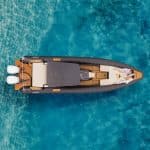
Size matters in the caves, and smaller is almost always better. A compact RIB or open speedboat can enter caves that a larger yacht cannot approach, hold position inside narrow chambers, and reverse out quickly if conditions change. The Sea Dreamers fleet includes vessels specifically suited to cave exploration — boats that combine the power to make the open-water crossing to Paxos with the manoeuvrability to navigate inside the grottos. Full details of the Paxos boat trip and the Paxos and Antipaxos full day tour are available on the Sea Dreamers website.

Frequently Asked Questions
Can I swim inside the Blue Caves?
Yes, and it is encouraged. Most of the caves on both Paxos and Corfu are swimmable, and the experience of floating inside a cave with blue light rising from beneath you is the highlight of the visit for many guests. Your skipper will advise which caves are safe for swimming on the day based on sea conditions, and will typically anchor the boat just outside the entrance while you swim in.
Do I need snorkelling experience?
No. The caves are accessible to anyone who is comfortable in the water. Snorkelling gear enhances the experience — seeing the cave floor and the underwater portion of the rock formations is genuinely spectacular — but a simple swim without gear is equally worthwhile. Life jackets are available for those who prefer additional buoyancy.
Are the caves crowded?
It depends on the time and the season. The Blue Cave on Paxos and the Paleokastritsa caves on Corfu are the most visited, and in July and August they can see a steady stream of boats between 10:00 and 15:00. A private boat tour has the advantage of flexibility — your skipper can visit popular caves at off-peak times and take you to lesser-known formations that the group tours skip entirely. Early morning and late afternoon are the quietest periods.
What if I am claustrophobic?
Most of the caves are large, open spaces with wide entrances and high ceilings — they do not feel enclosed in the way that a land cave might. The Blue Cave and Ipapanti, in particular, are spacious enough that claustrophobia is rarely an issue. For smaller, tighter formations like some of the Grammatiko passages, you can simply choose to stay on the boat or swim in the open water nearby while others explore inside. There is no pressure to enter any cave you are not comfortable with.
Plan Your Cave Visit
The sea caves of Paxos and Corfu are among the Ionian’s greatest natural features — geological formations that produce colours and atmospheres found nowhere else in the region. Seeing them properly requires a boat, a knowledgeable skipper, and the right conditions. To arrange a cave-focused boat tour, contact Sea Dreamers and we will plan a route that covers the best caves accessible on your chosen date, timed for optimal light and minimal crowds.


 English
  Greek
Greek  Italian
  German
  Spanish
  Romanian
  Hebrew