The Albanian coast is visible from Corfu on any clear day — a dark ridgeline across the strait, barely two nautical miles away at the narrowest point. It is close enough to feel like a neighbouring parish, yet crossing that strip of water takes you into a different country, a different currency, a different tempo entirely. From the beaches of Ksamil, where the water rivals anything the Greek islands can offer, to the Ottoman-era waterfront of Saranda and the ancient ruins of Butrint, a day trip to Albania by boat from Corfu is one of the most varied and rewarding excursions available in the Ionian.
The Crossing
The strait between Corfu and Albania varies in width from approximately two to fifteen kilometres depending on where you cross. From Corfu’s northeast coast — around Kassiopi or Agios Stefanos — the Albanian town of Saranda is a short hop across open water, typically twenty to thirty minutes in a fast boat. The channel is generally calm, sheltered by Corfu to the west and the Albanian mountains to the east, though the current can run surprisingly strong in places. It is one of the quickest international border crossings you will ever make by sea.
The approach to the Albanian coast is striking. The mountains rise steeply from the shoreline, and as you draw closer, the landscape shifts from the green, wooded slopes familiar from Corfu to something more rugged and less developed. Small fishing villages dot the coast, and the water — if anything — becomes even clearer as you move away from the more heavily visited Greek side of the strait. The first sight of Ksamil’s islands from the sea, scattered like stepping stones in a shallow turquoise bay, is one of those arrivals that earns its reputation.

Passport and Border Requirements
Albania is not in the European Union, and a border crossing is required. EU and UK passport holders do not need a visa for stays of up to 90 days — a valid passport is sufficient. US, Canadian, and Australian citizens also enjoy visa-free entry. Your passport must be valid for at least three months beyond your date of entry. Bring the physical document; a photocopy or digital version will not be accepted.
When arriving by private boat, the entry process is handled at the port of Saranda, which has a border police station that processes incoming vessels. Your skipper will coordinate the formalities — typically a brief passport check and a registration of the vessel. The process takes fifteen to twenty minutes and is straightforward, though it is worth having your documents ready and accessible rather than buried in a dry bag at the bottom of the boat. On busy summer days, there may be a short queue of incoming vessels, but the wait is rarely significant.
Important: children travelling with only one parent may be asked for documentation of the absent parent’s consent, depending on the border officer. Carry a signed letter of authorisation if this applies to your group.
Ksamil — The Islands and Beaches
Ksamil sits at the southern tip of Albania, directly opposite the northern end of Corfu, and it has become one of the most talked-about beach destinations in the eastern Mediterranean over the past decade. The reason is immediately obvious on arrival: a cluster of four small islands in a shallow, turquoise bay, surrounded by white sand beaches and water so clear it seems to have no colour at all until you look straight down and see the seabed four metres below.
The main beach at Ksamil stretches for several hundred metres and faces the islands directly. It is developed — sunbeds, beach bars, restaurants — but retains a rawness that the more polished Greek islands have long since paved over. The prices are notably lower than on Corfu: a seafood lunch with wine at a beachfront restaurant costs a fraction of what you would pay in Kassiopi or Corfu Town. The islands themselves are accessible by swimming (the nearest is perhaps a hundred metres offshore) or by paddleboard, and they offer small, quiet beaches with fewer people than the main strip.
Arriving by private boat gives you a significant advantage here. You can anchor directly off the islands, swim to deserted stretches of sand that the shore-based visitors cannot easily reach, and move between the islands at will. The water around the Ksamil islands is some of the most photogenic in the region — shallow, warm, and intensely coloured.

Saranda — The Waterfront Town
Saranda is the main town on this stretch of coast, a small city of around 30,000 that has grown rapidly as Albania’s tourism sector has expanded. The waterfront promenade is pleasant — palm-lined, with cafes and restaurants overlooking the bay and Corfu visible across the water. The town has a distinct character: part Mediterranean resort, part post-communist reinvention, with concrete apartment blocks sitting alongside new boutique hotels and a general air of a place that is evolving quickly and confidently.
For a day visitor, Saranda offers a chance to stretch your legs, browse the shops along the main street, and sample Albanian coffee culture (strong, Turkish-style, served in tiny cups with an intensity that will recalibrate your caffeine baseline). The waterfront restaurants serve excellent grilled fish and meat, and a meal for two with drinks rarely exceeds twenty to twenty-five euros. The fresh seafood — caught that morning, often by the owner’s cousin — is superb.
The ruins of the fifth-century synagogue, discovered during construction work in the 1980s, are worth a brief visit. The mosaic floor is intact and impressive, and the site sits just above the waterfront within easy walking distance of the port. For a broader view of the town and the strait, climb to the Lekuresi Castle on the hill above — the panorama from the top, encompassing Corfu, Ksamil, and the open Ionian, is exceptional.
Butrint — The UNESCO World Heritage Site
Eighteen kilometres south of Saranda, on a peninsula jutting into a coastal lagoon, lies Butrint — one of the most important archaeological sites in the eastern Mediterranean and a UNESCO World Heritage Site since 1992. The site spans nearly three thousand years of continuous habitation, from a Greek colony founded in the seventh century BC through Roman, Byzantine, Venetian, and Ottoman periods. Walking through Butrint is like reading geological strata of human civilisation: a Greek theatre carved into the hillside, a Roman forum, Byzantine baptisteries with intact mosaic floors, a Venetian watchtower, and Ottoman fortifications, all layered on top of one another within a compact, forested peninsula.
The setting is as compelling as the ruins. Butrint sits at the edge of a lagoon teeming with birdlife — herons, cormorants, and occasionally flamingos in the shallows. The peninsula is densely wooded with oaks and Mediterranean pines, and the path through the ruins winds through dappled shade that provides welcome relief from the summer heat. The site is well maintained and intelligently signposted, and it is possible to see the highlights in ninety minutes to two hours.
Reaching Butrint from the coast requires a short taxi or minibus ride from Saranda (roughly twenty minutes each way) or from Ksamil (ten minutes). Your skipper can arrange ground transport or advise on the most efficient way to include Butrint in a day trip itinerary. For history-minded travellers, Butrint alone justifies the crossing from Corfu; combined with Ksamil and Saranda, it makes for a remarkably full and varied day.
Food and Lunch Recommendations
Albanian cuisine draws on the same Mediterranean larder as Greek cooking — olive oil, fresh vegetables, grilled meat and fish, feta-style cheese, yoghurt — but with its own accents and traditions. A day trip offers a chance to sample some of these.
In Ksamil, the beachfront restaurants serve excellent grilled fish (the daily catch, sold by weight) and simple salads of tomato, cucumber, and local feta. The calamari is reliably good, and at a fraction of Greek island prices. Try the tavë kosi if it is available — a traditional Albanian dish of baked lamb with yoghurt and rice that is comfort food of the highest order.
In Saranda, the waterfront restaurants offer a wider menu. Grilled octopus, mussels saganaki, whole sea bream, and mixed grills of lamb and pork are standard fare. The quality is high and the portions generous. Albanian wine is underrated — the white wines from the south, made with local grape varieties, pair well with seafood and cost very little. Albanian raki (grape brandy) is offered at the end of the meal with the same frequency and insistence as in Greece, and refusing it is considered mildly impolite.
Budget roughly 15 to 25 euros per person for a substantial lunch with drinks at a good restaurant on either the Ksamil beachfront or the Saranda waterfront. Cash is preferred; Albanian Lek is the official currency, but euros are accepted universally at a reasonable exchange rate. Most restaurants have card machines, though they do not always work.

How Much Time Do You Need
A comfortable Albania day trip from Corfu takes six to eight hours. A shorter half-day trip (four to five hours) works well if you focus on Ksamil only — cross, swim, eat, return. Adding Saranda for a town walk and lunch extends the day modestly. Including Butrint requires the full eight hours, as the site alone deserves at least ninety minutes, plus the drive time from the coast.
A suggested itinerary for a full day: depart Corfu at 09:00, arrive Saranda for border formalities by 09:30, continue to Ksamil for a morning swim and early lunch by 11:00, drive to Butrint at 13:00, explore the ruins until 15:00, return to the boat, and arrive back in Corfu by 17:00. This is relaxed rather than rushed, with time for lingering at each stop.
Which Boat for the Albania Crossing
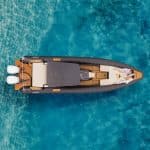
The crossing to Albania is short and generally calm, so the boat choice is more about comfort and group size than seaworthiness. A fast RIB handles the crossing efficiently and is ideal for couples or small groups. A larger vessel offers more space for families and the comfort of shade on the return journey. Sea Dreamers can advise on the best option for your group — full details of available vessels are on the boat rental page. The dedicated Albania day trip tour includes border coordination, route planning, and ground transport for the Butrint excursion.
Frequently Asked Questions
Do I need a visa to visit Albania from Corfu?
Most nationalities, including EU, UK, US, Canadian, and Australian passport holders, do not need a visa for stays under 90 days. A valid passport (with at least three months’ remaining validity) is required. Your skipper handles the border entry formalities at Saranda port. The process typically takes fifteen to twenty minutes.
Is it safe to visit Albania?
The southern Albanian coast is a well-established tourist destination and is very safe for visitors. Saranda and Ksamil are busy resort areas with a visible police presence and a well-developed tourism infrastructure. The standard precautions that apply anywhere in southern Europe — watch your belongings, avoid dark alleys at night — are sufficient. Crime against tourists is rare.
What currency do I need?
Albanian Lek (ALL) is the official currency, but euros are widely accepted at tourist-facing businesses in Saranda and Ksamil. The exchange rate offered by restaurants and shops is usually reasonable, though not as favourable as an ATM withdrawal. Carrying 50 to 100 euros in cash is sufficient for a day trip covering lunch, drinks, and any souvenirs. ATMs are available in Saranda town centre.
Can I use my mobile phone in Albania?
Albania is not in the EU, so EU roaming regulations do not apply. Most European mobile plans will charge roaming fees for data and calls in Albania. Check with your provider before crossing. Free WiFi is available at most restaurants and cafes in Saranda and Ksamil. Alternatively, switch your phone to airplane mode and use WiFi only to avoid unexpected charges.
Book Your Albania Day Trip
Albania is Corfu’s most surprising neighbour — a country that has transformed dramatically in recent years, with beaches that rival the best in Greece, archaeological sites of genuine international significance, and a hospitality culture that makes every visitor feel welcome. The crossing by private boat is short, scenic, and straightforward, and a full day combining Ksamil, Saranda, and Butrint delivers an experience that most travellers rate as the unexpected highlight of their Corfu trip. To arrange your crossing, contact Sea Dreamers with your preferred dates and group size, and we will plan the route, coordinate the border formalities, and make sure you see the best of what this coast has to offer.


 English
  Greek
Greek  Italian
  German
  Spanish
  Romanian
  Hebrew